Category to differentiate trip reports from other posts. Make sure this category is assigned to all trip reports, otherwise they will not be shown in the main web page.

Through Chowilla

Four day downstream meander in the creeks of the Riverland, 7- 10 Apr 2023

The River is Green

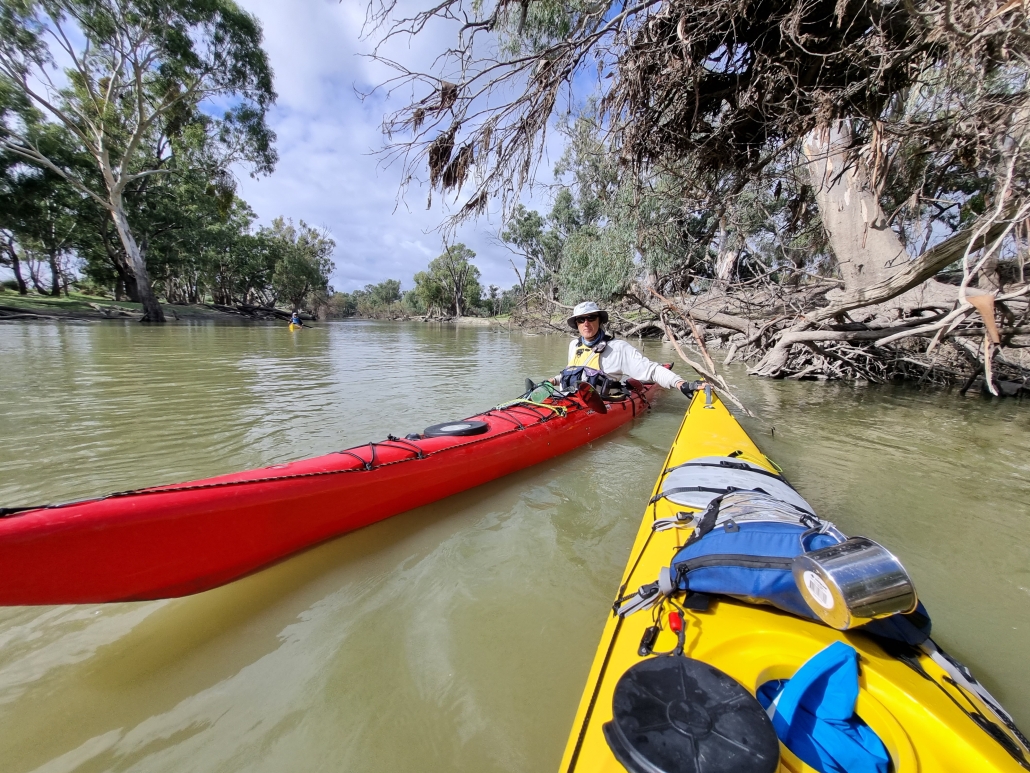
Five kayakers headed up to the Riverland to inspect the aftermath of the recent floods by paddling all the backwaters from the Chowilla Reserve back to just before Renmark, a distance of 68kms. Happily we can report that the river levels are back to normal, most businesses are open, and the whole area is looking magnificent: I have never seen it so green with so much bird life. If you can, get up there to have a look, the floods have done wonders for the countryside.

Good Friday

Charlie in the MurrayWe started our trip on Friday lunchtime from the launch spot near the Customs House Houseboats, crossed the river to get into Suders creek and off the Murray as soon as possible. Suders creek was its normal fast-flowing self, but now (thanks to the floods) with a new tree stuck right in the middle of the channel at the fastest spot, with associated eddies. This resulted in one capsize and a few near misses, not a good start to the trip! After getting organised again, we continued down the creek, avoiding the many snags to set up camp on Chowilla creek.

Leisure Saturday

A leisurely start next morning saw us paddling slowly down Chowilla creek, assisted by the current while we watched the scenery. A pair of wedge tailed eagles was spotted, along with many straw-necked ibis and the more common sacred ibis. We were also fortunate to see a lot of Black-tailed native hens, which we have never seen before. Apparently they are nomadic and take advantage of temporary wetlands, so the conditions after the floods must be ideal for them.

At the end of Chowilla creek we reached the Murray and turned left for a few kilometres to look for the next creek which would take us into Hunchee, and then RalRal creek. We stopped at the Chowilla Woolshed for lunch, where the full extent of the flooding became apparent; we were sitting on the bank at least 2 meters above the river, and could see the flood marks another 1 meter up on a building. Trying to estimate how wide the river would have been at the level was truly scary, I’m sure it must have been difficult to even find the main channel of the Murray at that level.

A Short Shower on Sunday

The third day dawned cool and overcast as the others had, but this time we were treated a short shower of rain, luckily we were all in our kayaks with wet weather gear on so we didn’t get much wetter than we already were. After turning off into RalRal creek we had a short detour to have a look at Lake Woolpolool, but the water levels were already too low to get over the regulator and into the lake itself. Maybe next time.

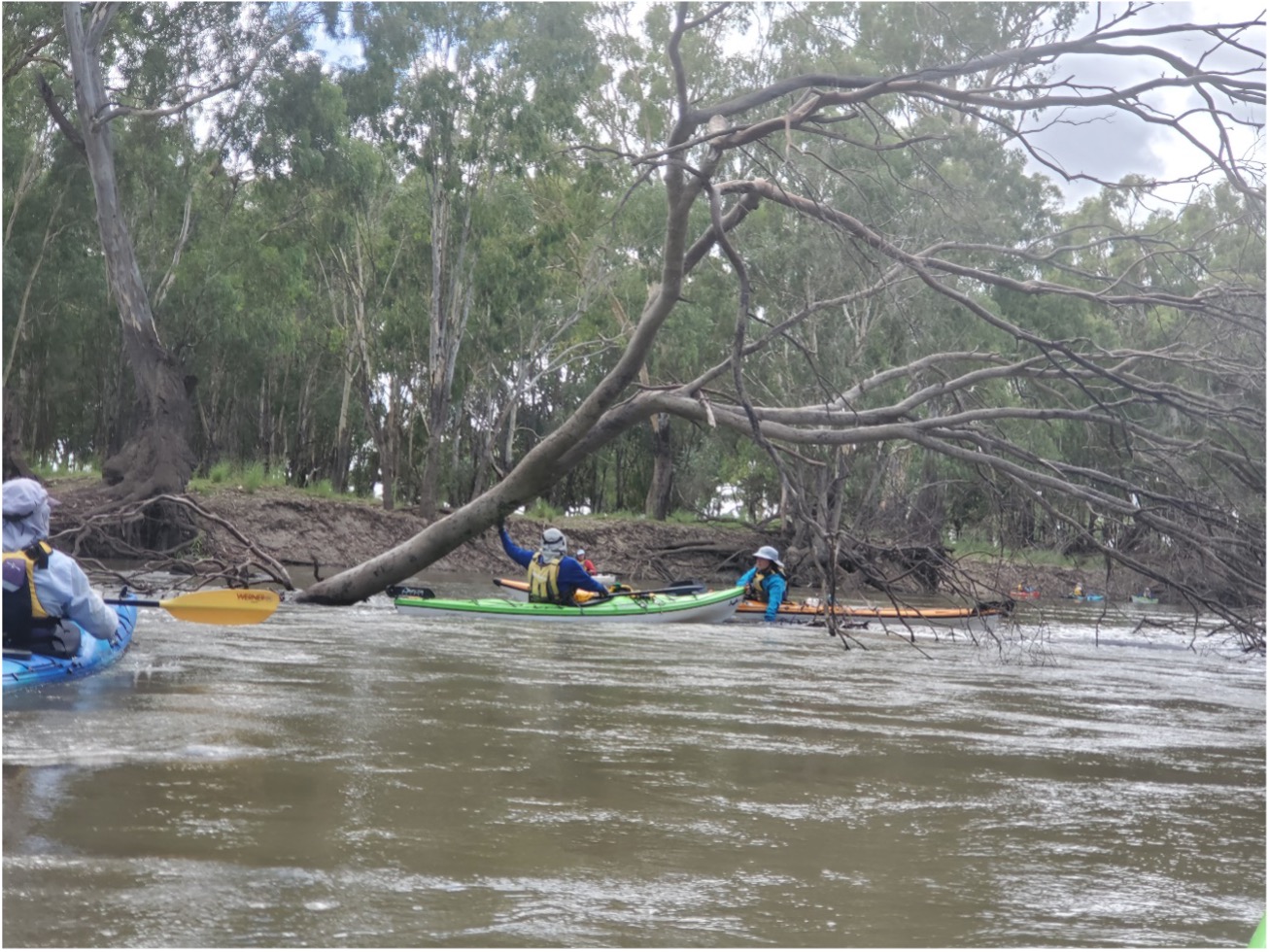
Portage in ChowillaJust after that there was a bit of excitement where the creek narrowed into almost a small rapid under a low bridge, with a tree waiting in the river downstream. With memories of Suders creek still fresh in our minds, some of us opted to do a short portage to avoid the obstacle, while the rest of the group took it in turns to carefully paddle through. Luckily it wasn’t as bad as it looked and no-one else went swimming.

After a leisurely paddle down the RalRal Wide Waters (which is actually a lake wider than the Murray itself), we found the entrance to Nelbuck creek and set up camp for the night. Peter put out his yabbie net and managed to supplement dinner with 2 nice size yabbies, although cooking them in a small hiking stove was a bit of a challenge.

Wrap up Monday

Next morning we continued down the creek back into the Murray and had a brief stop at the old Woolenook Internment Camp from World War II. Nothing much is left of it now except for a few plaques, but worth a look.

Another kilometre or so down the Murray and we found the imaginatively name Inlet creek, which we followed into Horseshoe Lagoon, and from there navigated our way through the creeks and lagoons back to Canoe-The-Riverland, where Ruth and Jim had kindly let us leave one of our cars for the shuttle back to our launch spot.

If you feel like a paddle in the area, be sure to contact them. They do organised tours and kayak hire, and have the best maps of the area: https://www.canoetheriverland.com/


Departing from Cape Jervis

Crossing Backstairs Passage – Cape Jervis to Antechamber Bay and Return — 18/19th March 2023

The adrenaline has finally stopped racing through my veins to allow me to tackle the promised trip report of our crossing of Backstairs Passage to Antechamber Bay and return on the weekend of 18/19th Mar 2023. What a paddle, with a SE gusting to 20Kn and seas over 2m at some stages. All paddlers did extremely well without any incidents, but special recognition should go to our two crossing first-timers: Abelardo Pardo and Simon Delaine.  Talk about jumping into the deep end!  Conditions in Antechamber Bay didn’t look too bad at departure, but steadily escalated during the return crossing.

Preparations

It was a great turn-out with twelve (12) paddlers participating. The trip was led by Phil Doddridge with Charlie Walker, Matt Eldred, Mark Loram, Mike Dunn, Peter Vincent, Anthony Aardenburg and Bella, Tresh Pearce, Abelardo Pardo, Simon Delaine and recent member Karl Meyer following Phil’s lead. Similar to our crossing in March 2022, the trip was aimed at demonstrating the splitting of the tide to achieve the most efficient crossing.

Four of the group (Mark, Simon, Abelardo and Phil) drove down on Friday Night and camped at the Cape Jervis Caravan Park ready for an early morning start. We used this site when training for our Bass Strait crossing and had fond memories of relaxing amongst the pines at the rear of the Park overlooking Backstairs Passage.

A lovely evening soaking up the view and not a ripple seen looking over to Penneshaw. In the evening the highlight was looking up towards the sky and counting the satellites passing overhead – I have never seen so many, there seemed to be a continuous stream passing just below the Southern Cross. A strong wind came up overnight which eased in the morning, but which probably should have been a warning of an approaching front.

Day 1 — The easy one

Enjoying the crossingUp and about around 6am and met the remainder of the group at Cape Jervis Boat Ramp in time for an 8.30am on-water start.

After loading kayaks (I overdid the equipment list again!) and after the safety briefing from Phil we set off at about 8.45am, following the coast east to Lands End to avoid the ferry’s path. We then set our bearing for Cape Coutts and headed out on our adventure, with a few whitecaps between us and the safety of Antechamber Bay; just east of Cape Coutts we were on our way.

A pleasant paddle across but no wind advantage which disappointed those with sails in the group, just a solid slog for 5 hours before we made Antechamber Bay, even explored a bit of the sandy beach to eventually reach Chapman River. Just checking that the mouth hadn’t moved!

Many hands made light work of the portage across the beach and we were soon paddling up the picturesque Chapman River, admiring the paper bark trees and new bridge as we approached campsite no 12 that Mike had kindly booked.

Setting Camp

After setting up camp most of us relaxed, enjoying the location while others went paddling to explore the upper reach of the Chapman River.

Once again the campground was pretty busy so we made an early appearance at the camp kitchen, admiring the stunning views. We had a very pleasant evening there – night solar lights might be handy, a note for future trips! The kitchen is very well set up and we spent the evening discussing kayaking adventures while being entertained by Tresh’s attempts to get his cooker operational.

Soon after we turned in and slept well, being serenaded by several Boobook Owls during the night. In the morning some fairy wrens visited, very elusive but I did manage to get a couple of pics as they checked out my tent.

Day 2 — The not so easy one

On our way to Antechamber BayNo rush in the morning with the plan to be on-water in Chapman River by 10am, bit of drizzle overnight and the additional time was put to good use sponging the tents and gear and getting packed up.  We said our farewells as we paddled under the KI version of Sydney Harbour Bridge and down to the mouth for another portage. The waters in the bay looked calm but the forecast for the crossing was increasing winds 15 to 20Kn SW. The sky towards Deep Creek threatened to bring squalls during our crossing.

The briefing was a bit somber and Phil gave the group the option of returning via the Penneshaw ferry instead of attempting a borderline crossing – we all mulled it over but the mutual decision was to paddle the return as the group was fired up to complete the crossing. These sort of situations are always difficult with experienced kayakers, particularly with several having done crossings in similar conditions.

We split into sail-assisted kayaks and those just going with the swell, although on the starboard beam. We headed off together before separating into two groups, with those sailing heading directly across the passage towards Deep Creek before following the coast back to Cape Jervis while our group of five (5) made a beeline for Cape Jervis. There was no time to relax on the four (4) hour return paddle, it certainly required continuous attention.  Phew, all back in the safety of Cape Jervis boat ramp by 3pm.

Arrived

Together in the bakerySunday’s return crossing was by far the most challenging that I have done and I breathed a sigh of relief when we all arrived back at Cape Jervis safely, with the sailors having arrived about 15 minutes prior to the non-sail group.

Looking back, the return paddle was probably borderline, but to achieve the crossing without incident is a credit to the experience within the Adelaide Canoe Club. This is due to regular sea kayak training provided to Club members over several years particularly from Phil Doddridge, Bernard Goble and Peter Carter. All of the group are also regular paddlers, both at Club events and privately, regularly working on improving their skills. The paddlers conducted themselves in a very professional manner exhibiting a good appreciation of group dynamics to ensure we all remained safe.

All of us wanted to celebrate and swap stories, so we adjourned to the Yankalilla Bakery to debrief. And yes, the adrenaline was flowing strongly for quite a while afterwards!

Braving the waves in West Beach

Paddling on a Winter Day in Summer

Impromptu Paddles through WhatsApp

A bit of winter weather in the middle of summer doesn’t stop Adelaide Canoe Club members from braving the unseasonably weather. We cancelled the Thursday Evening Skills session at Tirana Way. But this was soon replaced with an impromptu surf session at the Adelaide Sailing Club on 5/Feb.

The surf was rolling in along the coast. Charlie posted an ad hoc surf session in our WhatsApp channel, and therefore, outside of the calendar. The unpredictable weather is showing that this channel is allowing  paddlers to connect and get out on water. At the time of writing this post, the channel has 43 club members.

The winter day

We had Charlie Walker, Bella and Anthony (and Leigh), Giresh Chandran and Mark. We were braving the 25 knots plus winds with the sand blasting in our faces (and on the cars)!

Braving the waves in West Beach

Conditions looked challenging when we arrived at 5.30pm. We decided to use the protection of the Boat Ramp rock wall with some good waves forming inside the harbour. Lots of surfers were just outside the northern rock wall, so we didn’t want to encroach on their turf.

We launched from the southern end of the beach and gradually made our way outside the harbour to experience the swell. Confidence gradually built as we paddled further out (some further than others).

When Charlie, Anthony, Giresh and Leigh warmed up they managed several successful runs into the beach – most without mishap – the pictures tell all!

Well done to Giresh on successfully managing to control his kayak in the soup zone with some perfect looking bongo runs onto the beach. Pretty impressive having only been introduced to low support strokes at the previous evening skills session at Tirana Way.

The adrenalin was running after we finished and cleaned up, so we adjourned to the protection of the Sailing Club to debrief and plan the next adventure, perhaps from Noarlunga depending on the interest from Club members.

Sunset at Murrumbidgee River

Murrumbidgee River, Darlington Point to Hay, 30 Jan – 4 Feb 2023

A good week in the oasis of the Murrumbidgee River

Anne and Simon Langsford lead a fantastic trip down the Murrumbidgee River, from Darlington Point to Hay. Paddlers included Berny Lohmann, Robert, and Robin Phiddian (AKA Rob & Rob), Terry Holder, Courtney Kirkwood, Simon Delaine, Hugh Stewart, and Peter Vincent. The group met at the Darlington Point caravan park on Sunday evening after a car shuffle that left two cars at Hay. It had been raining much of the late afternoon.

A bumpy start (Monday)

The weather cleared overnight for a 9 am start on the water, after parking the cars. Anne and Simon L gave a briefing about what to expect for the trip, including the dangers of snags lying under the water. The group slid their kayaks off the muddy banks, gathered in the water, and set off, passing under the Darlington Point Bridge. The river was flowing at a good pace, and it was nice being able to coast and watch the trees go by. But soon whistles were blown, and we turned to see an upside-down kayak! Robert had been pulled into some bushes and capsized.

Simon L, tailing the group, swiftly rescued Rob, and his kayak, though Rob’s paddle was lost in the roll, likely dragged underwater and lost in branches. The group continued down the river, learning how to spot dangerous ripples in the water. Unfortunately, one was spotted too late, and Terry badly hit a snag on the side of his boat which soon began leaking. We applied duct tape  as a temporary repair, luckily mostly holding for the remainder of the trip. We made camp after 36km.

Days without incident: 0 (Tuesday)

Another 8:30ish start on the river. A smooth day of paddling until Terry capsized on a snag after lunch. This got us accustomed to calling out snags as some can be easy to miss. Bird life was proving to be wonderful. Australasian Darters were spotted, and Rainbow Bee-eaters visited our camp late in the evening. Despite a shallow stream of water flowing right beside our camp, the mosquitos were not as bad as we had feared. This was a theme for the whole trip.

Getting into the groove (Wednesday) 

Last night ‘boat-monitor’ Berny heard water lapping at the kayaks, so he rose to shift some forward. Each morning it was clear the water level had risen. Being day three, everyone was quicker getting their boats packed. Saw the first small motorboat of the trip. We came across some shortcuts on the river which we took advantage of after checking enough water was flowing through. Peter, in his durable plastic kayak, checked on one shortcut but had to turn back. We had westerly winds for much of the day and by the end most people were getting exhausted. Started looking for campsites, but a few good options had houses nearby. Eventually found a suitable camp in a small forest reserve after travelling 43km. Many of us enjoyed a refreshing swim close to shore where the current wasn’t too strong.

Halfway (Thursday)

I (Simon D) didn’t check the elevation between my tent and the river last night. Turned out it wasn’t much, and the rising water got very close! Another quick getaway this morning and we soon passed a bridge marking the very approximate halfway point. It was a windy day but luckily there weren’t too many straight sections of river, plus everyone’s fitness levels seemed to be rising so we were mostly able to power through it. Rob & Rob were doing a remarkable job keeping up in their much smaller 12ft Carolina Perception kayaks. Saw more birdlife today, including Yellow-billed Spoonbills, Sacred Kingfishers, and Peter was excited to spot a White-bellied Sea Eagle after spotting them on previous trips. We made camp after 42km, landing on a beach beside a large, forested area. Some enjoyed another swim and wash. The wind became quite intense in the evening, and we retreated to our tents for an early night.

‘Love the fallen tree’ (Friday)

It was a very windy start to last night but not all of us had the same experience. Hugh had his tent flattened soon after getting to bed, yet Terry said he heard the wind but barely felt it. The day started with action when Courtney backed up from shore into a branch and capsized. Luckily her insulated coffee floated. The wind was still blowing so she put on a cag to prevent wind chill. Today was forecasted to be the windiest day and it felt like it.

We came across an interesting section of river where a tree had fallen most of the way across. Peter and Berny were up the front and chose a zig-zag route to the right. However, the middle route at first look seemed viable. Courtney was next and chose the middle section but found a large log laying just beneath the surface. Fortunately, she acted quickly, remembering the advice given at the start of the trip, and leaned into the log to prevent the flowing water from capsizing her boat (a technique known as ‘love the rock’ in white water kayaking). She did well to keep calm while flowing water kept her kayak pressed up to the log, as Simon L and Peter devised a rescue plan.

After Peter traveled back upstream, Simon L attached a rope between Peter and Courtney’s boats. Some hard, upstream paddling from Peter eventually freed Courtney’s boat from the log. A good rescue effort. Though slower in the straight sections, Rob and Rob’s shorter, plastic kayaks cruised through these tight sections. At lunch break Simon L had the group discuss what happened. We reflected on how crucial the ‘love the rock’ technique was in that situation as it’s unknown how big that log was or what lay beneath the surface. In future tight sections, we held paddles above the head horizontally, earlier, to hold the group back while the front-runner (mainly Peter) found a safe route.

Back on the water after lunch, we heard barking dogs by a house and Anne said on the last trip the dogs tried to herd them off the river. This time we sneaked by without the dogs noticing. During the afternoon tea break, we discussed how much longer to continue as campsite opportunities would become less frequent the closer, we got to Hay. A short, sharp shower fell after setting off for the final leg before camp.

After 41km we pulled onto a wide beach for camp. The weather was kind enough to let us set up tents before unleashing wind and rain. Simon L set up a tarp for the group to shelter under, and this action seemingly stopped the rain. Turned out this campsite is a bit of a rookery for White-necked Herons now, with many nests scattered high in the forest. These White-necked Herons were abundant for most of the trip, taking advantage of all the recent wet weather.

Back to civilization (Saturday)

A perfect start to the final day. The wind and rain of yesterday had mostly subsided and the sun was out but not too hot. We pulled up for morning tea on a beach about 18km from Hay. Anne said they’d tried to camp here on a previous trip but were told to move on as the farmers were planning a party. Hugh, Peter, and I decided to sprint the final stretch into Hay. The whole group made it into Hay by around 1:30 pm after 30km. People were relieved to have made it and surprised by how fast the trip went. Simon L looked after the kayaks while Anne and Berny drove everyone else to pick up their cars from Darlington Point. The group farewelled Rob & Rob and the rest drove back to Hay for a pub dinner at the New Crown Hotel. Now, off to clean a muddy kayak.

Tour of Lefevre Peninsula

The Loop

Great suggestion from Mike Dunn on the WhatsApp channel on Friday for a paddle with a difference – doing a loop of the Lefevre Peninsula. The plan was to  launch from the Outer Harbor area, paddle down the Port River, portage across Bower Road into West Lakes, paddle south to Oarsman Reserve,  portage again across Military Road over the Tennyson Dunes and into the sea again – just in time to catch the southerly wind for the 13km final leg back to Outer Harbor. Distance was estimated to be about 28km. We had an ebb tide to begin the paddle so expected to work on our way up the Port River.

I felt I couldn’t resist Mike’s suggestion and was feeling pretty good about our Training Session at Tiranna Way on Friday so agreed to join up with Mike for his adventure.

The Start

Departure was from the small boat ramp just down from the Royal South Australian Yacht Squadron (RSAYS) at 9am, plenty of space for leaving our cars. Once we had loaded our very important trolleys for this paddle, as it requiring a couple of portage sections we were on our way by 9.30am.

Our sightseeing started with the Container Terminal – no shipping in sight so we explored underneath the concrete wharf which looked all very well maintained. As we approached Port River past the Snapper Point Power Station the ebb tide was very evident and even managed to practice some ferry gliding.

Mutton Cove Conservation Park

We had the river to ourselves as we paddled up past Mutton Cove Conservation Park. It’s great to see the increase in mangrove growth. This was a regular lunchtime break and the area has gradually improved, largely thanks to the local community group.

The regeneration of Mutton Cove Conservation Park become very evident as we approached ASC and were almost swept into mid channel by the tidal flow coming out from the small creeks that have been restored. This was all noted as a potential area for some whitewater skills practice when tides are favorable.

We made sure we were on the correct side of the Exclusion Zone buoys of the ASC building to ensure we didn’t set of any alarms. Brought back lots of fond memories to see a Collins Class Submarine on the Hardstand outside the Production Shed. The work on the Offshore Patrol Vessels (OPVs) seems to be progressing well with one in the water for final fit-out prior to Trials and another on the hard stand under construction.

Snowden Beach

Near Snowden Beach we spotted a small wooden boat in the distance. As it approached we saw it was skippered by club members Bernard and Frances Goble. They were doing a Sea Trial prior to departing for the Wooden Boat Festival in Hobart. Bernard had previously given Mike a call to advise that we might encounter them on water. We kept them company as we paddled into Port Adelaide and stopped at Cruickshanks Beach for a leg stretch and lunch.

After lunch our little flotilla continued on its way under the Birkenhead Bridge. We past all the construction happening around the old Fletches Dock and then up into Port Creek and what used to be called Port Misery when sailing ships moored there.

Crossing Bower Road

Water was becoming shallower as we approached the railway bridge before Bower Road. We said our farewell to Bernard and Frances. It was great having their company as we explored the Port. I’m sure our little flotilla was observed by a few of the locals.

We soon ran out of water after managing to navigate the many small rocks leading up to Bower Road. We must approach the council about a nice sandy beach for future trips! The portage across Bower Road went well, interesting dodging traffic with a 5m kayak in tow.

The new home for Paddle South Australia and West Lakes Canoe Club is looking near to completion. It should be a great venue for aquatic activities. We rolled our kayaks down to the beach and were soon back on water for the West Lakes leg of the paddle. Plenty of rowing activity around so we kept out of the way as we approached PAC Rowing Sheds and a busy event.

The forecast southerly had picked up as we approached West Lakes Boulevard bridge. And yet another surprise as we approached a group of kayakers – club members Bella and Anthony out on the water with visiting family.

Oarsman Reserve

We soon reached Oarsman Reserve and brought out our trolleys again. We navigated Military Road and found our way down to the beach via the backstreets of Tennyson. Much easier portage and no rocks to avoid.

The wind had certainly picked up and we searched the horizon for Matt Condon paddling his Audax up from Semaphore to join us on our final leg.

After safely getting through the surf on the Tennyson sandbar we headed further out and headed for Semaphore with Matt. Swell was on our beam and wind picking up so we delayed putting up sails until we reached Semaphore South when the wind was on our backs. I hadn’t used my sail for over 12 months. I asked Mike to stabilize my kayak until I got the Pacific Action rigged and we headed towards Largs Bay. All went well and Matt kept us company until Semaphore then headed back to his beach.

No wind

We had Outer Harbor breakwater in sight but the wind had dropped considerably. Down sails and back to paddling – just as well as the conditions as we rounded the breakwater were very messy but thankfully no water traffic around. Soon had the Overseas Terminal in sight then around the corner and back to our departure point. We both agreed we would sleep well that night after 32km and roughly 6.5 hrs in our kayaks. A fantastic paddle in various conditions with lots of interesting sites on the way.

Thanks Mike for organsing and many thanks to Bernard, Frances, Bella, Anthony (and family) and Matt for joining us during our adventure.  This is definitely a paddle that we will repeat, so keep your eyes on the calendar.

Eildon white water, 9-13 January 2023

Many ACC paddlers will associate the annual Eildon White Water trip with Wayne and Libby. Wayne has been involved in instructing on the trips since 1985 and Libby joined in 1990. Wayne says this year’s trip was their last, so we take this opportunity on behalf of all those paddlers that have learnt and enjoyed white water paddling because of their instruction to say a big THANK YOU.

First Day

The river level this year was lower than usual, which exposed previously covered rock features and gave us many options of eddies and waves to play in. Scott started us all doing some warm up exercises in small eddies above the main area, perfecting our edging, strokes and body position before coming down to the main area to spread out and play. Wayne broke his usual rule and tackled The Sump rapid on the first day, successfully. The floods earlier in the year rearranged The Sump rocks so once again the wave was different. Monday and Tuesday saw us all enjoy and hone our skills in the rapids alongside the caravan park.

Wednesday

On Wednesday we travelled up to Big River. The level there was higher than our usual. It was 0.6m, so we didn’t hit as many rocks on the way down. The narrow river made negotiating some rapids quite technical, which was fun. Unfortunately, flooding left too much debris in the Slalom Rapid to make it feasible for us to paddle it so we portaged around and then played in the wave below the rapid before continuing on to the pull out point near the road bridge. The scenery around Big River makes for a very enjoyable day’s paddling.

Thursday

Thursday morning we took the boats up to the dam wall and had an enjoyable paddle down, through the S Bend rapid and back to the caravan park. Our last afternoon was filled with playing around the top features then Wayne, Scott, Simon, Steve and Charlie progressed down to enjoy The Sump. There were a few capsizes, some rolls and only a couple of rescues.

This was a great week paddling white water. Thanks to our instructors, Scott and Wayne, we improved our skills and had lots of fun. Think about joining us next year to experience the exhilaration of white water paddling.

Happy paddlers at Myponga Reservoir

Exploring Myponga Reservoir and Pizza at Smiling Samoyed — 3 December 2022

Quiet water in Myponga Reservoir

Quiet water in Myponga Reservoir

Judging by this paddle at Myponga Reservoir, summer has finally arrived and we couldn’t have asked for a better day. The Reservoir is looking stunning at the moment. Good growth of duckweed in the shallows and a dark colouration of the water due to the level of tannin in the water – providing an interesting contrast for photographs.

Paddlers were Julie Rohde, Kim Wooning, Mark Loram, Julie Keast, Matt Eldred, Berny Lohmann and Terry Holder. Well done to Julie Keast (“Keasty”) on giving up her Canoe Polo Bat and trying out a Sea Kayak – see you at Semaphore South paddles hopefully!

The 7 knot northerly wind put in a brief appearance but had minimal impact for most of our paddle. A few fishing kayaks out but generally pretty quiet – must be lots of people attending the VALO Adelaide 500.

On the water

Traversing the Myponga Reservoir

Traversing the Myponga Reservoir

We were on water by the civilised time of 10.00am. We set off for a leisurely paddle exploring the accessible boundaries of the Reservoir in a clockwise direction. Had our lunch stop just past the line of buoys looking up to South Road before getting back on water and making a beeline for the dam wall.

The buoys and underwater structure act as a containment barrier in case of a road tanker crash, isolating this part of the Reservoir from the main body of water.

Took the opportunity for a group photo while in sheltered waters – well done Julie for demonstrating good kayak balance. We even managed another pic at the dam wall.

After passing along the dam wall exclusion buoys we headed to the northern shoreline, taking the opportunity to explore some of the interesting little inlets. The smell of the pine forest was very noticeable and made us feel like were paddling in amongst the forest.

We were soon back at the boat ramp and rolled the kayak trollies back to the almost empty carpark.

Final Stop

Next stop was The Smiling Samoyed Brewery with plenty of time to enjoy our pre-ordered pizza – what a great way to finish off a paddle around Myponga Reservoir. Next Reservoir excursion will hopefully be Warren Reservoir up near the Barossa.

GPS Image

GPS Myponga Sat 3 Dec 2022

Polo game at Tintinara

Canoe Polo at Lake Indawarra, Tintinara — 19 November 2022

Polo team at Tintinara

Polo team at Tintinara

Having a weekend away, camping at Tintinara and playing polo in Lake Indawarra has become an annual event (expect for the Covid interruption). The polo field was set up on Friday with about half the players arriving in time to pitch camp and head to the local pub for dinner. On Saturday morning we floated and attached the goals to the field and then everyone was ready for play to commence at about 10am. With four teams there was enough time to have two complete round robin competitions, giving everyone 6 games during the day. There was a short break when the forecast storm, complete with large hail stones, lightning and thunder, went through but when the storm passed everyone was back out enjoying the last of the games. Games were close with several ending in draws, but overall Sharkzilla came away triumphant. After the games there was a BBQ roast spit dinner and lots of great company and good conversation.

Canoe Polo Competition

Thanks to the Tintinara Action Group who allow us to use their shed and facilities at the lake. Their support for our canoe polo event is greatly appreciated.

Kayaks in the beach in Coffin Bay

Coffin Bay — 7-11 November 2022

Head wind

The weather forecast for the week at Coffin Bay National Park was looking great as Bernard, Francis, Charlie, Marina and Anne set off from Coffin Bay township on Monday 7th November. With a 10-15 knot north easterly wind we paddled along the cliff edge on the northern side of the Bay We gained some advantage from the easterly component and sheltered from the northerly aspect until we crossed Mount Dutton Bay. The wind hit us again as we crossed above The Brothers Islands and made our way along the coast to Black Springs campsite. It wasn’t long

Seal behind a 2 person kayak with two sails up

Seal playing with the kayak at Coffin Bay

before we had set up camp and were relaxing.

Trying to get to Point Longnose

The plan for Tuesday was to paddle around Point Longnose and make our way to Morgans Landing camp. However, the forecast calm wind turned into at least 15 knots from the north and the swell was predicted to be about 2m. We battled into the head wind through the oyster farm to Point Longnose and beached the kayaks on the more sheltered side. Francis and Marina looked after the boats while Bernard, Charlie and Anne went to check conditions on the exposed side. The wind was very strong and it was whipping up waves which would have been breaking side-on to us along Seven Mile beach.

Back top Black Springs to see the eclipse

To continue would have given us about 12 km of very difficult paddling so we decided to retreat back to Black Springs. While we were checking conditions around Point Longnose a large wave and strong gust launched Charlie’s kayak back into the sea and quickly took it out of reach. Marina jumped into her kayak and managed to grab it but without a tow line to return it to the sandbar. She was stuck in waist deep water with a deep trench between her and the sandbar. We needed to work out how to reunite Charlie and his kayak. Bernard and Frances managed to ‘deck carry’ Charlie out to Marina and then it was easy to get everyone back into kayaks.

Moon eclipse in Coffin Bay

Moon eclipse in Coffin Bay

The strong northerly wind made sailing back a great option for those with sails. Anne and Marina decided to go around the coast while Bernard, Francis and Charlie planned to sail directly back. Luckily we did a radio check before we split the group and we had not gone far when we had radio contact that Charlie’s rudder wasn’t working and we collected together on the beach for repairs. That sorted we returned to camp, more or less as a group with some sailing nearer camp. In the evening as we walked along the beach we noticed the moon rising, but it didn’t look right. We checked Google and discovered we were seeing a total eclipse of the moon in progress.

Heading back

Wednesday’s winds were predicted to be even stronger and we woke up to rough seas and about 27 knot winds so we opted for a bushwalking day and visited the lookout to Black Rocks in Avoid Bay. We walked a little further along the cliffs and found an enormous Osprey nest perched on a rocky island, with the resident bird standing on top of it.

The wind forecast for Thursday was a westerly (tail wind returning to Coffin Bay) and Friday was back to easterly (head wind returning to Coffin Bay) so it didn’t take much discussion to pick Thursday as our last day. With a good tail wind we made our way along the coast then across to The Brothers Islands to check on the birds and seals there. There was one seal that swam around our kayaks checking us out as we photographed it.

Multi-day kayak camping trip in the backwaters of the Murray river in the Chowilla reserve — 14 October 2022

Water Everywhere

There is a lot of water in the Murray at the moment. So much so that all the campsites in the parks are closed due to flooding. We even considered  cancelling this trip. So glad we didn’t. Murray river may be high and flowing too strongly to paddle easily. But all the backwaters are even higher, with easy paddling and lots of normally dry creeks now easily navigable

The launch from near the Border Cliffs Campground was easy thanks to the high water levels. No scrambling down steep banks! We paddled slowly across the river as the current took us downstream to the entrance to Suders Creek. This creek is normally narrow and fast-flowing, and can be challenging. This time it was wide and easy. The usual obstacles were under water and we could paddle in amongst the trees that were normally high and dry on the banks.

From there we headed up Salt Creek and took advantage of the high water to investigate a normally dry creek. This route took us back to Hypurna Creek via some newly created wetlands. An unexpected treat was spotting a pair of wedge-tailed eagles, with what looked like a newly built nest. No sign of chicks, but it was hard to tell with the nest being so high. A short paddle up Hypurna Creek and we reached our campsite for the next two nights. We quickly put up tents, chairs and tables and we settled in to relax for the rest of the afternoon.

The Big Loop

Setting up camp

Next day was a relaxed start as we did not have to pack up camp. We did a nice easy circular route planned with unloaded kayaks, to bring us back to the same campsite. Started paddling slowly up Hypurna creek, which was sometimes confusing due to all the new channels which were now open, thank goodness for the trusty GPS. We were accompanied for a short period by some emus, which seemed curious more than alarmed, and allowed us to get really close. I guess they didn’t know what to make of these brightly coloured things floating on the water.  When we reached Salt Creek we opted to take the longer route to the Murray, this is normally not navigable without a portage due to a causeway. This time there was no sign of the causeway or the bridge which were marked on the map.

We reached the Murray River, paddled a whole 100m downstream, and went back into the other entrance to Salt Creek. Must be the shortest distance I’ve ever paddled on the Murray. Our aim was to get back to a small creek which was not on the map, but now had plenty of water and was flowing from Salt Creek in the direction of Wilperna Creek, which was where we needed to go.

Wilperna Creek is normally a small, winding, snag choked place, today it was a broad, open river, and we made good time following the current downstream towards our campsite. All went well until a kilometre before the turnoff to the campsite, where we inadvertently took a wrong turn into yet another creek which wasn’t on the map. We soon realised our mistake, but the creek was flowing in the right direction, so we continued along and magically popped out into the right creek just above our campsite.

The Scenic Route

Paddling Hypurna Creek

Next day the camp was quickly packed up and everyone was feeling good. We decided to take a more scenic route back to the cars. We paddled down Hypurna Creek which, in places, resembled a lake rather than a creek, and spent our time trying to pick out the normal course of the creek amongst all the flooded trees. Then we bypassed the normal portage back to the Murray, and also Suders Creek (which we could have easily paddled up in the current conditions), and continued down Slaney Creek for another 3 kms to a small creek which joined up with the Murray.

We had never paddled this creek before due to the imposing regulator at the entrance, which is normally impassable without dragging kayaks up steep banks and through thick bush. This time the water had bypassed the regulator, and we all paddled past without even getting out of our kayaks.

Back in the Murray, we crossed over and hugged the bank out of the main current as we paddled the last kilometre back to the cars. Getting the laden kayaks out of the water was easy thanks to the conveniently high water levels. We were soon packed up and heading to Renmark for the customary debrief at the bakery.

Map and GPX file

Click in the image below to access the map of the trip and its corresponding GPX file

Wilperna and Hypurna Creeks