Category to differentiate trip reports from other posts. Make sure this category is assigned to all trip reports, otherwise they will not be shown in the main web page.

Semaphore South Peer Paddle — 9 January 2022

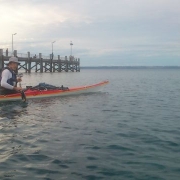
Towards North HavenEight of us (Matt, Bella, Anthony, Anthony, Abelardo, Bruce, Simon D and Nicholas) departed the sunny Semaphore South shores with almost no wind, very flat seas and lots of sunshine. Along the way to North Haven, we navigated through fleets of yachts, stand up paddlers, and boaties out fishing. Simon had his new kayak out for its longest paddle yet, which was completed with apparent ease. Some took a break at North Haven beach while others practised manoeuvres. The way back was a little more work, with headwinds up to 14 knots and the water a little more lumpy – yet it was still very pleasant. No one was eaten by sharks, run over by yachts, nor had aircraft land on them. So all-in-all, a successful paddle!

Thanks to Nicholas for pictures and very entertaining report.

Happy Valley Reservoir — 9 January 2022

This was the first event held at Happy Valley Reservoir since the opening on Sat 11th December 2022. Paddlers were Jo Molsher, Anne and Simon Langsford, Wayne Hooper and Libby Robertson, Peter Drewry, Michael Griffin, Courtney Kirkwood and son William, Lisa Kerley, Esther Yip, Mike Dunn and Mark Loram behind the camera.

Jo Molsher has been a member of the Community Reference group for the Reservoir and as the Opening Day approached, she has been suggesting we establish Happy Valley as a regular paddling event. Based on today’s attendance with 13 members booking there will be many returns to this lovely and very handy location. The paddle was organised and led by Jo with the intention of her leading regular paddles at Happy Valley. Everyone enjoyed the morning and there was plenty of support with Instructors Wayne, Libby, Anne, Simon and Mark in the background.

Getting Started

Paddlers started arriving just after the scheduled opening time of 7.30am. A wise move, as it wasn’t long before the carpark was starting to fill up. This is understandable so soon after the opening day and it was a perfect day to be out on the water. After being tempted to stop at the on-site coffee van, we drove cars down to the Kayak Drop-off Point and unloaded before going in search of a carpark. There are three (3) main areas just back from the launch point, but cars can also be parked along Chandlers Hill Road or Berkeley Road. For future paddles, we suggest bringing along a trolley, getting a park on arrival and then walking your kayak down to the launch point.

There was plenty of activity on arrival with several fishing kayaks being launched and very excited children running around with fishing rods. The dam walkway was also very busy with walkers and joggers enjoying a day out. This is also a great location to get out and explore the dam perimeter with an early morning walk.

After Jo’s briefing we helped each other on water and set off in an anti-clockwise direction. Given that the perimeter is only about 4km, we opted for a couple of circuits with a drink stop mid-way.

Relaxing in the Reservoir

We had a very relaxing paddle around the perimeter and the day couldn’t have been better. Hardly any wind and barely a ripple on the water. It provided a great opportunity for all paddlers to update each other on Christmas and New Year activities as well as the occasional kayaking tale – the subject of whitewater paddling came up when we passed the southern inlet; with a bit more flow it would be great for demonstrating the principles of whitewater paddling (similar to West Lakes Outlet).

This site also brought back some memories for Libby, growing up on an adjoining farm and getting washed down the inlet sluice as an adventurous 13-year-old – and here are a few of Libby’s memories:

“The Adelaide Canoe Club paddle on Happy Valley Reservoir last Sunday was a great day for me, full of nostalgia.

I was brought up at “The Pines” O’Halloran Hill, the farm directly south of the reservoir. Our house was built by Captain Hallett (nearby Hallett Cove is named after him) in the 1840s.  My father, as a returned serviceman after World War 2, was permitted to run a pump from the reservoir to our farm. This was a great privilege providing excellent reliable water for the farm, in particular my mother’s dairy. I often went with him to check on the pump. Because of this, I knew how to gain access to the reservoir.

In my teens, I and three of my local friends, went for a picnic/wander there, in the middle of winter. Unfortunately, while exploring a little East of our pump, I fell into the outlet channel bringing water from Mt. Bold and was unable to climb out up the cement wall. My friends frantically ran along-side, offering sticks to help me get out, to no avail. The result was that I was swept into the reservoir proper. I was then able to swim to shore and come out through the mud to the grassy bank. Of course my clothes had to be dried and me warmed up, by a small fire, before returning home. My parents wondered why I smelt so smoky.

My parents never heard of the escapade until I had children of my own!

On Sunday, I was very pleased to see that the channel is still there today and was flowing (however it has shrunk in length and depth from my memory of it over 60 years ago!) Wayne was excited to see the fast flowing water, a potential site for white water practice, unfortunately OUT OF BOUNDS!

Wrap up

Thank you, Jo Molsher for organising this paddle. We are so glad that paddlers and fishers are allowed to legitimately enjoy the reservoir on and beside the water, but not in it. Esther looked very comfortable in her Dancer and showed good directional control while keeping up with the sea kayaks. Also good company for Wayne and Libby in their Dancers. After doing a bit of post-paddle research, I have discovered that Happy Valley Reservoir was constructed in 1897 with water being fed from Mount Bold Reservoir via the Clarendon Weir, and more recently the Desalination Plant.

The tower on the reservoir is called a Scour Tower and apparently is used to capture water for the water treatment plant (to be confirmed).

We were off water by 11am after a very pleasant paddle on a perfect day. Many thanks to Jo Molsher for the initiative and big welcome to new member Esther on her first paddle with the Club since taking out membership earlier in the week.

Kayaks with birds in the bckground

Tolderol Bird Sanctuary: Lake Alexandrina, Coorong — 5 December 2021

Twelve paddlers took advantage of the gentle winds forecast for Sunday morning to go for a gentle paddle amongst the reed beds of Tolderol Bird Sanctuary on Lake Alexandrina.

Tolderol is a well-regarded bird watching location, reed beds along the lake shore, grassy banks and shallow basins attract a wide variety of water fowl and migratory wader bird species. Late spring and summer are the best times to see the migratory birds which flock to this area. It is not a very well used park, with few amenities, and is not very well signposted.Birds starting to fly

On the water

Despite this everyone managed to find the designated meeting point, and we were on the water by 9:30. At the first opportunity we turned off the lake and entered the maze of the reed beds. Having a GPS with a track showing the route from our last visit should have made things easier, but trying to figure out how to work a brand new GPS on its first outing, along with finding some of the previously navigable routes now reeded over, made for some anxious moments. Aided by Bernard volunteering to stand up in his kayak to try and find us a route to open water (he didn’t capsize, ruining a good photo opportunity), we didn’t have too many dead ends, although we did have to push through some thick reeds a few times. All part of the fun.

We took advantage of the only dry(ish) ground around to have an early lunch stop. Peter Drewry showed some great foresight by bringing along a camp chair, the rest of us had to make do with sitting on the grass, carefully avoiding the sheep droppings. The nearby fence made a great place to hang up wet paddling gear, until somebody pointed out that it was an electric fence! We are still not sure if it was active or not, as nobody was brave enough to test it.

The return

Stretching the legsBy now the wind was starting to pick up so, with discretion being the better part of valour, we packed up and headed back to the launch spot by a more direct route staying to the outside of the reed beds, getting back to the cars by early afternoon. The winds in the Coorong have a habit of blowing up unexpectedly, and with the shallow waters things can become tricky very quickly.

Oh, and by the way we did see birds, lots of birds. See the pictures.

Campground site and sunset

Katarapko: Murray river backwaters 19-21 November 2021

Six brave paddlers ignored the weather forecast of “showers with possible heavy showers” to drive up to Katarapko in the Murray River National Park for a weekend of camping and kayaking the backwaters of the Murray River. Fortunately the weather forecast was wrong, there were no heavy showers, just showers! Most of the group arrived Friday lunchtime, slightly delayed due to road closures and new roads that didn’t quite seem to agree with what the map showed.

Setting Camp

After setting up camp quickly we all jumped into the kayaks for an afternoon paddle. The river level was probably 2m higher than normal, due to strong flows in the Murray and an artificial flooding event that was in progress. As a result some normally dry creeks were now navigable. We took the opportunity to spend a few hours exploring Piggy creek before returning to camp. Highlight of the evening was waiting for Abelardo to arrive. Everyone was curious to see if he would navigate the route in the dark, never having been there before. Fortunately he arrived safely, having benefited from some last minute instructions.

Rainy Saturday

Two paddlers in the Murray River

Two paddlers in Katarapko Creek National Park

Saturday morning arrived overcast, but no rain to speak of. We headed up Katarapko creek to the junction with the Murray river, and then into Sawmill creek which was very navigable thanks to the high water levels. From there we turned right into Eckert creek and followed that up into Eckert Wide Waters Lagoon. By this stage the rain had increased to a steady drizzle. It was not unpleasant and we kept up a good pace as no-one wanted to stop and get out of their kayaks. We found the northern entrance to the Wide water with no problem, and kept paddling up Eckert creek.

The increased water helped with this, but also made it hard work going up the current. We reached the Murray and, since no-one wanted to stop for a break, immediately started on the downhill run back to camp. We made good time with a strong flow in the Murray helping us along. After a very scenic shortcut through the Ajax Achilles Lakes we arrived at Lock 4. Due to the good pace we had been making, this resulted in an enforced lunch stop as the Lockmaster was having his  from 1 to 2 o’clock.

After a hasty lunch (still drizzling, and everyone was starting to get cold) we passed the time warming our hands on a public electric barbecues.  Eventually the Lockmaster arrived and gave the bedraggled paddlers a bemused look. After remarking that he could think of better things to do that day instead of paddling in the rain, he let us through the lock. From there it was a short paddle back to the camp and a warm cup of coffee and soup, just as the rain started to ease up followed by a glorious sunset.

Perfect Sunday

Paddlers in Katarapko CreekSunday morning dawned with no rain in sight and none forecast. After rapidly packing up, we eagerly paddled back up Katarapko creek, and Sawmill creek back up the Eckert creek. This time we turned left to head towards The Splash, an area which is normally narrow, but due to the low lying banks, spreads out into a large floodplain when the waters are high. First problem was a road bridge which we normally paddle under, this time we had to get out and do a short portage due to the water levels. Not much of a problem now that the weather was cooperating.

The Splash did not disappoint, as the creek spread out and we were soon paddling amongst flooded gum trees and bushes, admiring all the bird life which was now making the most of the sunshine after a few days of rain. Too soon we re-joined Katarapko creek, and had a stiff paddle back up to the camp-site, and a long drive home, broken by the customary bakery stop.

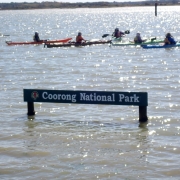
National Park Sign

Beacon 19 to Barkers Knoll 16 October 2021

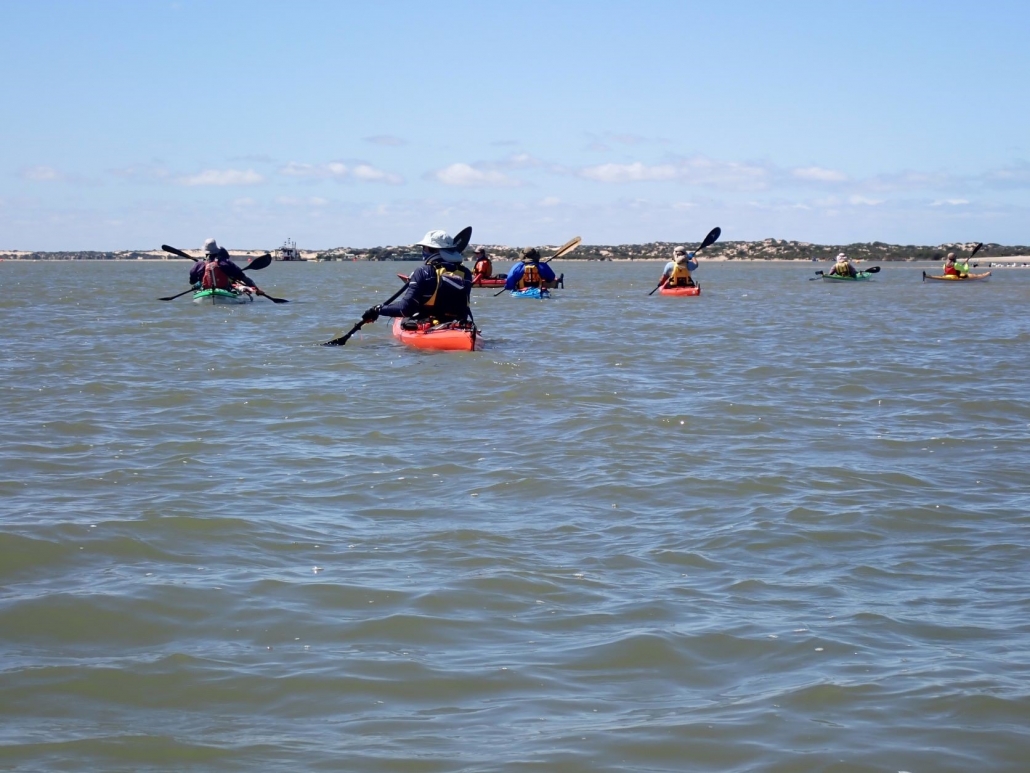
Perfect paddling conditions for the Beacon 19 to Barkers Knoll paddle on Sunday October 17. A lovely sunny day and a good sailing opportunity on the return leg.

It was great to see the large number of paddlers, especially considering that some had attended the Training Day at West Lakes the previous day.  Also, good to see  Greg Watts making the most of his drive down from Port Augusta for the weekend.

This was Shauna’s assessment day for Enclosed Sea Guide under the watchful eyes of Phil Doddridge. Shauna’s lead-up emails and briefings showed the considerable amount of work preparing for the trip. Under her leadership, paddlers were: Bernard and Frances Goble, Anne Langsford, Phil Doddridge, Mark Loram, Charlie and Marina Walker, Jo Molsher, Matt Eldred, and Greg Watts.

Paddling Upwind

Paddling Upwind

After 10am we set off from the Beacon 19 Boat Ramp on a nice leisurely paddle hoping to see plenty of bird life. We were not disappointed as we paddled towards the Murray Mouth. We saw numerous Black Swans as we navigated our way between the excitable cygnets rounded up by anxious looking parents.

As we progressed down the channel, those of us who hadn’t stopped for coffee looked longingly at the Coorong Café as we paddled past. Then the Spirit of the Coorong passed by heading towards the Murray Mouth. Some passengers raised their champagne glasses towards our group as they passed. Pretty sure they were heading further up the Coorong to Godfrey’s Landing for a lunch stop and walk through the dunes.

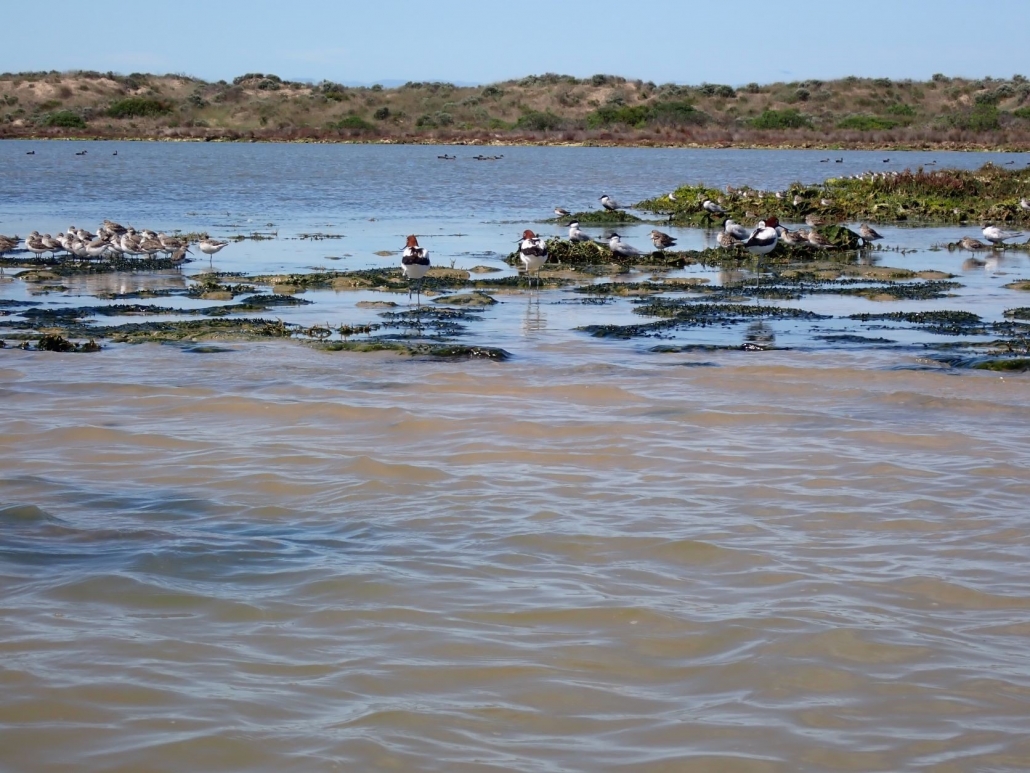
There were even more birds as we approached the Murray Mouth. I recognised (with help from Google!) a flock of Red Necked Avocet and Curlew Sandpiper on the sandbars. We missed our resident bird enthusiast – Peter Vincent on this trip. Also, numerous pelicans, but outnumbered by the black swans.

We could see the dredging barges at work as we approached the entrance to the Mouth.  Hopefully with more water coming down the Murray now and snow melt still ahead, dredging is reduced over the summer.

Taking a break

Taking a break

We stopped at the northern side and stretched our legs over the sandbars down to the Mouth. There were several 4WDs with families enjoying the setting. Some hoping to catch dinner while others just enjoying the view of the Mouth at the larger breaking waves.

After deciding on the safest track past the dredges we were on our way again passing the fishing shacks and making our way towards Barkers Knoll and our lunch stop. The wind picked up over lunch so several of the group were keen to be on our way for the return leg.

Wind was from the SE, making good conditions for the return run. Nothing like our usual 15kn runs, but still, lots of fun!  We were soon arriving at the Boat Ramp after covering 16km in just under 6 hours.

Phil conducted the debrief on our return and passed on the good news that Shauna had ticked all the boxes and he will be submitting the paperwork for Enclosed Sea Guide. Good work Shauna!, and we look forward to your next trip.

Launch at Panka Point

Paddling the Coorong – Parnka Point to Goolwa Sun 31 October – Tue 2 November 2021

I had been very keen to paddle the Coorong after reading about Mike and Tresh’s paddle in January 2021. We replicated their Salt Creek to Goolwa trip as a three-day trip in the club calendar for late October. Just when we were about to cancel the trip due to lack of bookings Matt Eldred booked. After a phone call we agreed on a plan to paddle the northern lagoon from Parnka Point to Goolwa (approximately 80km). Neither of us had paddled this part of the Coorong. After my paddle to Cattle Point with Mike, Tresh and Peter McLeod on the recent Snake Pit trip, I was keen to explore more, hopefully without the 35kn winds!

Getting there

Sailing in the Coorong

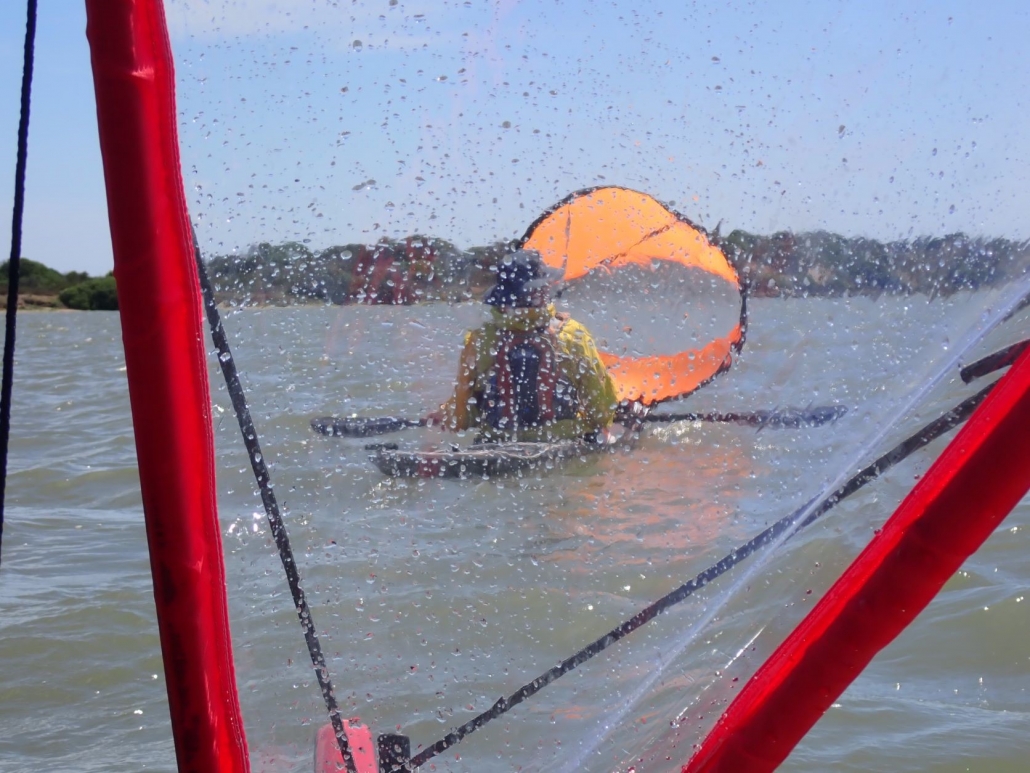
Kayak with a sail in the Coorong with the dunes in the background

We had transport (kindly arranged by Matt) from Strathalbyn to Parnka Point at 7:30am on Sunday 31 Oct. The countryside on my early morning drive looked great and judging by the crops, appeared to have had good rainfall. I arrived to Strathalbyn just after 7.30am, and we were soon on our way via the scenic route and a ferry crossing at Wellington. Coorong Park Rangers Chris Hannocks and John Gitchem (thanks to our Meningie member, Julie Palmer for the suggestion) advised that the water levels were the highest they had ever seen. Didn’t take long to get everything transferred and we were soon on our way. Our confidence increased as we observed more water in Pink Lake as we approached Meningie, so hopefully Coorong levels would be good as well.

Day One: Sunday 31 October

Arrived at Parnka Point about 9.30am ready for our first challenge – would everything fit into the kayaks?! Maybe we were not travelling so light after all, good to have a bit of contingency! Yes Tresh, I took some chai tea along as well as a nice slab of home-made focaccia to go with the cheese, and Matt brought some Green Ginger wine.

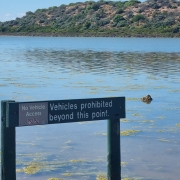
Looked a lovely day ahead of us, with only a hint of breeze, unfortunately from the north. Launching was easy, we set off about 10.30am just south of the Parnka Point Boat Ramp. Couldn’t resist getting a photo of the sign warning that cars were not to proceed any further. Yep, the Rangers were correct; plenty of water in the Coorong.

Shed in the Coorong

Shed in the Coorong

We spotted a couple of fishermen launching from the boat ramp, so Matt took the opportunity to ask about conditions. They were headed further south but confirmed we wouldn’t have a problem navigating The Needles. We paddled towards the Parnka Point Campground (discussing car camping opportunities on future trips) until we spotted what we thought was Needles Island. We had a perfect paddling day with a clear sky and calm water, great for paddling unknown waters with the channel clearly defined and easy to follow. There were sandbars, but easily spotted and avoided. The shallower water was covered in algae which did slow our progress somewhat and had to be occasionally cleared from paddles and kayak decks.

I kept having flashbacks from Mike and Tresh’s report, dreading having to drag our kayaks through the limestone reef around The Needles. We brought Matt’s Delta and my Prijon, so the last thing we wanted was a sharp limestone reef. The Kayak Gods must have been on our side as we paddled over the narrow channel with at least 0.5m of water. The Needles is well marked with a pole on the SW corner of Needles Island, and sections of the reef were clearly visible during our transit. We spotted several small birds foraging on the algae weed mat formed around the narrow channel. We became mesmerised by the scenery and calm conditions until the paddle blades encountered numerous limestone bommies.

The channel continued to be very pronounced and easily navigated, a stark contrast from Mike and Tresh’s experience. Aside from the waterbirds, we had the Coorong to ourselves, having left the one and only boat we encountered at the boat ramp. Wind was from NW around 5 to 6kn, so my sail remained stowed, however Matt managed to get some assistance at times after we cleared The Needles. The wind dropped mid-afternoon and changed to SSW from about 3pm, so we set the sails and sat back to enjoy the sand dunes rolling past. Only had about 5-6 kn from SSW but getting along at 6 to 7 km/hr. I said to Matt, with the sand dunes rolling by, it reminded me of a trip down the Nile River, just didn’t see any feluccas.

Around 1pm we spotted Camp Coorong, with several shacks visible from our mid channel position. Also passed a few well-established homesteads around the area. We had considered this as a start point, but after confirming water levels we opted for Parnka Point to check out the islands of North Lagoon – Rabbit Is, Snake Is and Needles Is. The scenery continued to improve, if this was at all possible as we paddled and sailed further north. The vegetation looked very healthy from the water, especially around some of the little bays we passed. Judging by the number of reedbeds, and bird populations these were freshwater soaks.

Setting camp

Our plan was to overnight opposite Long Point, which we reached around 5pm, so we selected a nice sandy beach and headed for shore. Not much room for tents so decided to continue north. Good decision as we would have had to share the beach with mozzies and an echidna that eagle eyed Matt spotted trying to escape our presence.

We were now north of Long Point and heading towards Nine Mile Point when we spotted what looked like a clearing behind a perfect beach, so in we went to explore! Discovered a perfect campsite area with plenty of room for several tents (noted for future trip!). Looking further we stumbled on a couple of old footings, signs of previous habitation, so continued exploring back into the clearing. We were blown away when we spotted an old shack nestled in the sand dune vegetation. Judging by the etching in the concrete footings (followed up with information from National Library), it was owned by George and Andy Ross, mulloway fishermen in the Coorong during the Great Depression years of the 1930’s. From a diary left in the shack it seems that it is gradually being restored by a group called the “Secret Shack Society”. Very important to retain these old buildings that depict early life on the Coorong.

The GPS showed that distance from Parnka Point was 37km, so not a bad day’s paddling with good assistance from our sails.

Still plenty of daylight so unpacked kayaks and set up camp, feeling very elated that we had discovered this little hideaway and a piece of SA history. Spent the evening talking about the highlights of the day and all the paddle options such as Car Camping at Parka Point or Long Point and exploring the section of the Coorong in more detail. Some of the dunes we passed were just stunning I will let the pictures speak for themselves. A very enjoyable evening, made even better with some cheese, focaccia bread, glass or two of red and some of Matt’s Green Ginger Wine. A very clear sky, so plenty of stars and satellites, much better than watching television.

Day Two: Monday 1 November

Woken up by sunrise just before 6am then got the day going with a nice cup of chai! No sign of wildlife around the campsite but plenty of fresh droppings around, so wallabies must have been grazing during the night. We did notice plenty of the small white snails glued to the tents and also on our PFDs. Also, Matt is now a bit more careful about putting his PFD on after discovering an interesting centipede who found a new home overnight. On the water about 9am, looking forward to another great day and wondering what we were going to see. The original plan was to make for Snake Pit, about 20km paddle, but opted for a shorter paddle to Lousy Jacks and enjoy the afternoon.

Coorong coast line

Coorong coast line

Managed to get some benefit from the sails with the 4 to 5kn NE winds – all good practice, especially with the Pacific Action sail. With the 28°C day and light breeze it was perfect for paddling the Coorong, the dunes were getting higher and more stunning as we approached Cattle Point. With the sails doing most of the work we were just mesmerised by the scenery – calm turquoise water, contrasted by green reeds from the freshwater soaks with a backdrop of golden sand dunes against the rich blue sky – wow! Landed at Cattle Point about 10.30am, while telling Matt about my last visit with Mike, Tresh and Peter McLeod – no 35kn winds this time. Just like last visit we were welcomed by a large flock of pelicans and smaller birds on the Point.

While Matt went climbing the dunes, I spent time recording this stunning location in a few photos and watching three fishermen on the point pulling in their nets, I assume for Coorong mullet. Unfortunately, they left before I had an opportunity to beg for dinner.

Matt returned after an interesting walk, all excited after discovering a large soak in between the dunes, dug down about 0.3m and found fresh water – good to remember if doing a solitary walk on the Coorong. Lousy Jacks was only around the point so back on water for leisurely paddle having a good close look at the shoreline around Cattle Point.

Soon had the tuart gums at Lousy Jacks in sight and made a beeline for the beach. We arrived before midday and just after fishermen had left – campfire was still warm and fish scales left around unfortunately. We selected our campsites either side of the tuart gums and set up camp. And then the mozzies arrived, not unexpected at Lousy Jacks, luckily we came prepared!

Setting camp

After getting settled, Matt decided on a walk across Younghusband Peninsula in search of cockles – about 1.6km across at this point. After making sure Matt had his phone, I settled into our lovely campsite enjoying the view while I read the “European Heritage of the Coorong” that Matt had brought along.

I breathed a sigh of relief when he returned safely. Looking very proud of himself with a small container with large Coorong cockles. I thought that was our dinner, but as we didn’t come prepared to cook cockles Matt tried to catch us a Coorong Mullet – we must have picked the wrong spot for fishing, although the pelicans seemed to be doing OK. Back to the dehydrated dinner again!

Another great evening under the stars and counting satellites, but turned in earlier on our second night as we knew the last day could be a challenging paddle, depending on the wind assistance.

Up early, at least I was! Matt took a bit longer as he didn’t get much sleep. He was visited by a Bull Seal during the night calling out for a mate. He tried getting up shouting and shinning his torch but to no avail! Check out the pics, the seal can be seen near Matt’s kayak. As if that wasn’t enough, apparently, we also had a fishing boat shining spotlights looking for a spot to cook their midnight snack. I obviously slept well, didn’t hear a thing!

Day Three: Tuesday 2 November

Back on water about 8.30am for our final day’s paddle to Goolwa, about 30km. Wind was forecast from NE to 18kn and again on our beam so would have to work hard with the sails. Needed to make the Barrage Lock by 4pm, so had a bit of flexibility depending on winds.

Real contrast on the water compared to last two days, overcast day, windier and gusty which made sailing a lot more challenging with the Pacific Action. Matt managed much better and I used the sail conservatively, not wanting to capsize.

Ended up getting more assistance from wind than expected, although we pretty well used the full width of the Coorong to get the best wind advantage. Bit of fun with the sandbars but no major problems.

We made good time and reached the Barrage Lock with 10 minutes to spare before it closed for lunch at 12.30pm, had to do a sprint on the final leg to get there! Short wait for a boat to come down from upstream, but wasn’t long before we cleared the Lock and made our way up towards Goolwa. Matt was on his phone arranging for his Dad to meet us at the Goolwa Wharf. It was about 1.30pm when we reached the small sandy beach just before the Wharf.

Over the three days we paddled 78km and managed to explore the northern lagoon of the Coorong in perfect days to see the Coorong at its best. Average speed was around 6km/hr with max run at 12km/hr. Not bad considering winds weren’t the most favourable. Hopefully with the Hume Dam currently being at capacity, we will have more water coming downstream with good opportunities for conducting a Salt Creek to Goolwa paddle in the new year.

Many thanks to Matt for keeping me company and organising the car shuttles, and particular thanks to Robert and Don for helping out. Enjoy the photos and keep an eye on the calendar for the next Coorong Trip.

Skill training

Skills Training Day – West Lakes 16 October 2021

Start of training session

Start of training session

A good turnout on Saturday 16 Oct for our training at West Lakes! Especially considering those nice spring days are a bit intermittent now! We had ten club members and two hopefully soon-to-be club members attending.

Members were Bernard Goble, Peter Carter, Mark Loram, Charlie and Marina Walker, Renata Perez, Abelardo Pardo, Simon Delaine, Greg Watts and Brian Slater. Both Greg and Simon are recent members and very keen to start attending regular trips. Greg had booked for Sunday’s Beacon 19 paddle, making the most of his drive from Port Augusta.

Big welcome to both Julie Palmer and Uday M for coming along as Trialist members. We are hoping to see you joining the Club and participate in future trips.

The car park was full when I arrived and Dragon Boats busy on the water– oops. I thought I’d checked the Calendar before setting the date! My panic was soon over, just an early morning training day from 6am, phew! Peter Carter was there nice and early and all prepped and ready to go. Our training time was a bit more civilised, 10.30am arrival for 11am start.

The Session

Skill training

Skill training

We began with new member introductions. It was great to see Greg coming all the way from Port Augusta and Julie from Meningie. After introductions we got Uday and Simon set up in the kayaks kindly arranged by Peter and Bernard. Many thanks to Bernard and Peter for helping with the Training and everyone else that participated in the Towing Exercise.

The day was a bit overcast with a hint of SW winds but as the day progressed things improved better than forecast. We started with warm-up exercises then went through primary paddle strokes on the grass before getting on water. We spent the next hour and a bit on water, primarily putting the strokes into practice.

The time flew by and soon the tummies started to rumble so we took time out for a short break. Short before we demonstrated various towing configurations on land. Peter’s kayak models came in very handy for showing group dynamics when setting up and changing over the tow. Again, all keen to put things into practice, so headed back on water.  We were soon tired out, so we returned to the beach to clean up the gear and prepare the BBQ.

The BBQ

Barbacue

Barbecue after the training session

The BBQ provided a great opportunity to talk about aspects of the training and the upcoming club events. New members went away happy, Peter had been “Spring Cleaning” his kayaking gear and brought along several very handy Flatwater and Sea Kayaking Booklets for our newbies. Many thanks to Abelardo for showing his culinary skills and cooking up the very tasty onions and snags.

Overall, a great day!

Bernard’s Kangaroo Island Challenge – solo 10 – March 2014

A Kangaroo Island Challenge!

Departing towards KI

An enthusiastic interest in sea kayaking will naturally lead to any one of us wanting to improve our skills, from paddling, personal fitness, an understanding of environment we are about to enter, our own readiness to set ourselves personal goals and the challenge of actually getting out of one’s own comfort zone!

Hugh Stewart and I after much paddling together on coastal trips including a Wardang Island circumnavigation now recognised each of our strengths and weaknesses and felt that with the right conditions, a crossing to Kangaroo Island together was feasible.

Fitness wasn’t an issue, boat preparedness was good, equipment carried was fine, our respective partners had even given approval, however, was Mother Nature going to play ball?

This is always the key factor in planning a paddle across the notorious Backstairs Passage, as two previous successful and some cancelled crossings for myself had clearly shown.

For a safe crossing, it’s essential to ensure that wind strengths, directions, wave and swell heights and very importantly, tidal movements are all carefully monitored and factored into any decision to attempt this paddle. Canoe SA and the Adelaide Canoe Club for years have offered excellent training and advice to enable ones skills to reach the required level and recognise which conditions are appropriate. My strong advice is, do not attempt this paddle without serious research, advice and training!

Our chosen day for the crossing was to be the Adelaide Cup Day, 10.3.14.  For several days prior, the forecast had shown favourable conditions, gentle to moderate winds from the south and tidal movement was minimal.

However, an important lesson is to never take forecasts “as gospel”, an 8 to 10 knot Southerly predicted, proved to be a 10 to 12 knot North Easterly on arrival at Cape Jervis.

This was actually ideal for our crossing and after 2 hours of surfing down 1metre waves we arrived at Cuttlefish Bay on the East coast of KI.  Whoohoo!!

Clearly, the weather wasn’t behaving as expected, so a call to American River Voluntary Marine Rescue confirmed that a trough of low pressure that had moved in could result in winds of 20 knots later in the day.

A decision to paddle south to Antechamber Bay into now Southerly winds of around 12knots along the dramatic eastern cliffs of KI was most rewarding. By lunch time, conditions were still very benign so we decided a return to Cape Jervis was quite achievable and by paddling initially to a more Easterly location of the Cape, a safety margin could be built in to our course should the southerly wind increase in strength.

Forty minutes after leaving Antechamber Bay and nearly 3Nm’s from KI, well into Backstairs Passage, conditions began to change rapidly. From the occasional white cap, very quickly a mass of white caps were developing.

Whilst still manageable, two choices were evident. Continue, but head in a more northerly direction up the Gulf to Cape Jervis and hope the wind strength didn’t increase too much more, or run diagonally with the sea back to Kangaroo Island. The latter was definitely one of the best Kayaking decisions we have made, as the wind did increase, a mass of rolling white caps developed further out in Backstairs Passage emphasising that it was certainly not a safe place to be in a kayak.

A long paddle surfing waves along the East coast of KI eventually to Penneshaw and a safe return crossing by ferry was the culmination of a great day of adventure Kayaking.

In conclusion, although the return paddle was not possible, the satisfaction in knowing that the years of training, skill development and  awareness of sea conditions led to all the right decisions being made, resulted in the trip being so rewarding.

Kangaroo Island is definitely one of Australia’s Kayaking jewels!

Bernard Goble.