

Murrumbidgee River, Darlington Point to Hay, 30 Jan – 4 Feb 2023
A good week in the oasis of the Murrumbidgee River
Anne and Simon Langsford lead a fantastic trip down the Murrumbidgee River, from Darlington Point to Hay. Paddlers included Berny Lohmann, Robert, and Robin Phiddian (AKA Rob & Rob), Terry Holder, Courtney Kirkwood, Simon Delaine, Hugh Stewart, and Peter Vincent. The group met at the Darlington Point caravan park on Sunday evening after a car shuffle that left two cars at Hay. It had been raining much of the late afternoon.
A bumpy start (Monday)
The weather cleared overnight for a 9 am start on the water, after parking the cars. Anne and Simon L gave a briefing about what to expect for the trip, including the dangers of snags lying under the water. The group slid their kayaks off the muddy banks, gathered in the water, and set off, passing under the Darlington Point Bridge. The river was flowing at a good pace, and it was nice being able to coast and watch the trees go by. But soon whistles were blown, and we turned to see an upside-down kayak! Robert had been pulled into some bushes and capsized.
Simon L, tailing the group, swiftly rescued Rob, and his kayak, though Rob’s paddle was lost in the roll, likely dragged underwater and lost in branches. The group continued down the river, learning how to spot dangerous ripples in the water. Unfortunately, one was spotted too late, and Terry badly hit a snag on the side of his boat which soon began leaking. We applied duct tape as a temporary repair, luckily mostly holding for the remainder of the trip. We made camp after 36km.
Days without incident: 0 (Tuesday)
 Another 8:30ish start on the river. A smooth day of paddling until Terry capsized on a snag after lunch. This got us accustomed to calling out snags as some can be easy to miss. Bird life was proving to be wonderful. Australasian Darters were spotted, and Rainbow Bee-eaters visited our camp late in the evening. Despite a shallow stream of water flowing right beside our camp, the mosquitos were not as bad as we had feared. This was a theme for the whole trip.
Getting into the groove (Wednesday)
Last night ‘boat-monitor’ Berny heard water lapping at the kayaks, so he rose to shift some forward. Each morning it was clear the water level had risen. Being day three, everyone was quicker getting their boats packed. Saw the first small motorboat of the trip. We came across some shortcuts on the river which we took advantage of after checking enough water was flowing through. Peter, in his durable plastic kayak, checked on one shortcut but had to turn back. We had westerly winds for much of the day and by the end most people were getting exhausted. Started looking for campsites, but a few good options had houses nearby. Eventually found a suitable camp in a small forest reserve after travelling 43km. Many of us enjoyed a refreshing swim close to shore where the current wasn’t too strong.
Halfway (Thursday)
 I (Simon D) didn’t check the elevation between my tent and the river last night. Turned out it wasn’t much, and the rising water got very close! Another quick getaway this morning and we soon passed a bridge marking the very approximate halfway point. It was a windy day but luckily there weren’t too many straight sections of river, plus everyone’s fitness levels seemed to be rising so we were mostly able to power through it. Rob & Rob were doing a remarkable job keeping up in their much smaller 12ft Carolina Perception kayaks. Saw more birdlife today, including Yellow-billed Spoonbills, Sacred Kingfishers, and Peter was excited to spot a White-bellied Sea Eagle after spotting them on previous trips. We made camp after 42km, landing on a beach beside a large, forested area. Some enjoyed another swim and wash. The wind became quite intense in the evening, and we retreated to our tents for an early night.
‘Love the fallen tree’ (Friday)
It was a very windy start to last night but not all of us had the same experience. Hugh had his tent flattened soon after getting to bed, yet Terry said he heard the wind but barely felt it. The day started with action when Courtney backed up from shore into a branch and capsized. Luckily her insulated coffee floated. The wind was still blowing so she put on a cag to prevent wind chill. Today was forecasted to be the windiest day and it felt like it.
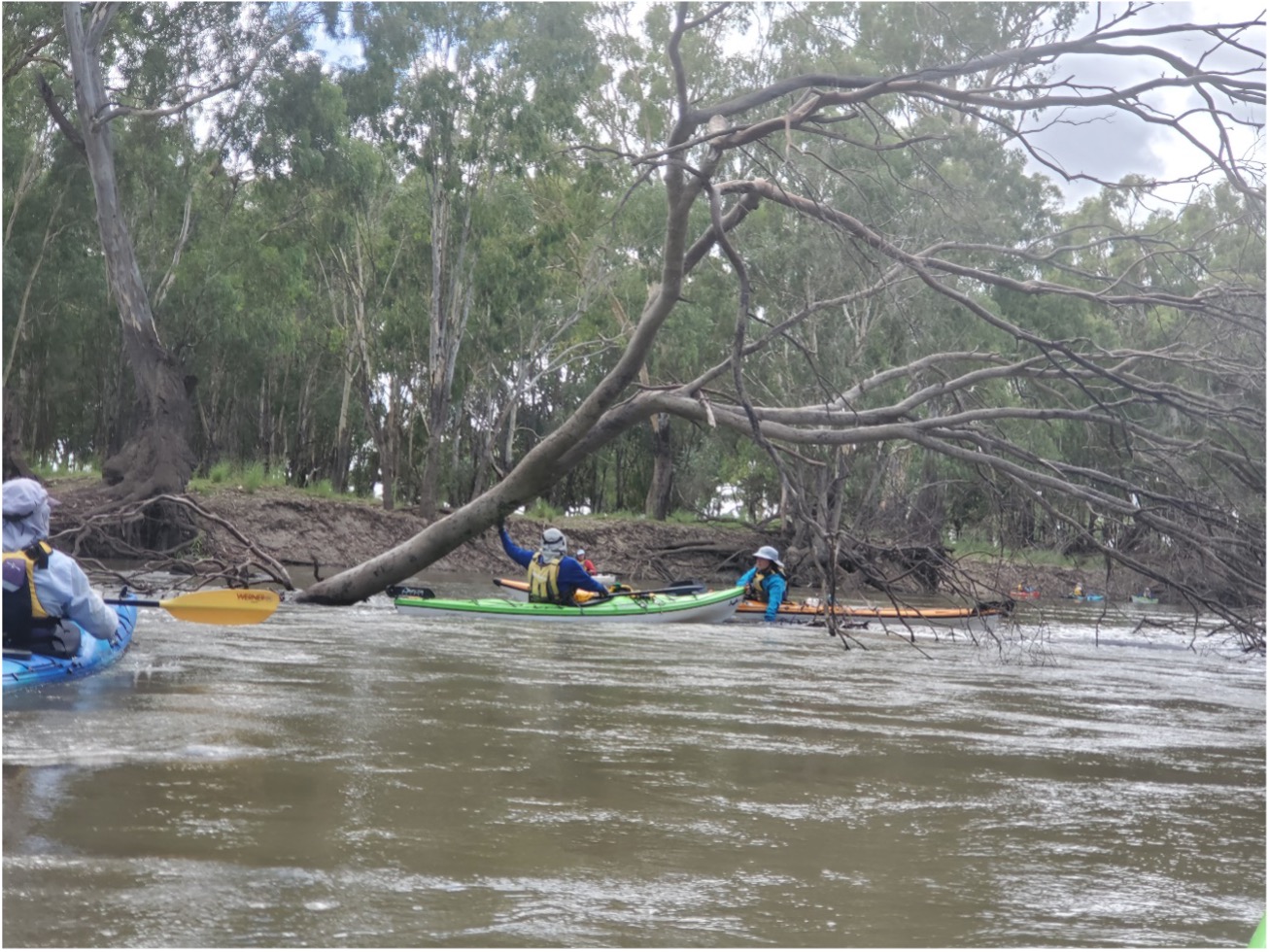
We came across an interesting section of river where a tree had fallen most of the way across. Peter and Berny were up the front and chose a zig-zag route to the right. However, the middle route at first look seemed viable. Courtney was next and chose the middle section but found a large log laying just beneath the surface. Fortunately, she acted quickly, remembering the advice given at the start of the trip, and leaned into the log to prevent the flowing water from capsizing her boat (a technique known as ‘love the rock’ in white water kayaking). She did well to keep calm while flowing water kept her kayak pressed up to the log, as Simon L and Peter devised a rescue plan.
After Peter traveled back upstream, Simon L attached a rope between Peter and Courtney’s boats. Some hard, upstream paddling from Peter eventually freed Courtney’s boat from the log. A good rescue effort. Though slower in the straight sections, Rob and Rob’s shorter, plastic kayaks cruised through these tight sections. At lunch break Simon L had the group discuss what happened. We reflected on how crucial the ‘love the rock’ technique was in that situation as it’s unknown how big that log was or what lay beneath the surface. In future tight sections, we held paddles above the head horizontally, earlier, to hold the group back while the front-runner (mainly Peter) found a safe route.
Back on the water after lunch, we heard barking dogs by a house and Anne said on the last trip the dogs tried to herd them off the river. This time we sneaked by without the dogs noticing. During the afternoon tea break, we discussed how much longer to continue as campsite opportunities would become less frequent the closer, we got to Hay. A short, sharp shower fell after setting off for the final leg before camp.
After 41km we pulled onto a wide beach for camp. The weather was kind enough to let us set up tents before unleashing wind and rain. Simon L set up a tarp for the group to shelter under, and this action seemingly stopped the rain. Turned out this campsite is a bit of a rookery for White-necked Herons now, with many nests scattered high in the forest. These White-necked Herons were abundant for most of the trip, taking advantage of all the recent wet weather.
Back to civilization (Saturday)
 A perfect start to the final day. The wind and rain of yesterday had mostly subsided and the sun was out but not too hot. We pulled up for morning tea on a beach about 18km from Hay. Anne said they’d tried to camp here on a previous trip but were told to move on as the farmers were planning a party. Hugh, Peter, and I decided to sprint the final stretch into Hay. The whole group made it into Hay by around 1:30 pm after 30km. People were relieved to have made it and surprised by how fast the trip went. Simon L looked after the kayaks while Anne and Berny drove everyone else to pick up their cars from Darlington Point. The group farewelled Rob & Rob and the rest drove back to Hay for a pub dinner at the New Crown Hotel. Now, off to clean a muddy kayak.


 Winds south westerly 0-5knots predicted felt like 8knots. The small group comprised of Simon Langsford, Peter McLeod, Matthew Eldred as trip leader. We gathered at Wally’s landing for the overnight paddle to Currency Creek. Peter was unable to stay the night due to work commitments and would return to the cars after lunch at Clayton Bay. We set off with the new paddle plan in place making our way through the reeds and into the lagoons to disturb the 100s of black swans that call it home.


 Launching from Garden Island boat ramp the group worked upwind across the Angus Inlet and some way up the Barker Inlet to get a fast downwind ride to the entrance to Hidden Creek. It has this name due to the entrance being indistinct and partially blocked by fallen trees. The entrance is on the eastern side of Eastern Passage just under the power lines. Once in the shelter of the creek conditions were ideal. Out of the wind it was much warmer, the water crystal clear and the winding nature of the creek made it feel adventurous! Phil and Bella were in a Mirage 730 double with Kaye and Stephen in their brand new Prijon double. Turning these longer kayaks to negotiate the ever sharpening bends tested sweep stroke technique, strength and endurance!
 Hindsight is a marvellous thing! Well before reaching the back of the creek we ran out of water, the tide was not quite ideal! And this is where the Bog challenge began! Those in single kayaks were able to turn around (just) to begin the journey out. No so those in double kayaks.
 There was no easy solution to get the M730 turned around so one end was shoved up onto the scrub and the rest lifted from the water to point it in the other direction. Phil and Bella then got in, taking quite a bit of smelly mud with them, and began paddling back. Well it was a mix of paddling, pushing off tree stumps and poling through the mud trying to weave through fallen branches and areas too shallow to float the boat!
 The wind was still blowing quite strongly so after a quick discussion Kaye and Stephen opted for a direct route back while others wanting more punishment headed on to the “Ships Graveyard”. It was a fun ride downwind and into the North Arm to view the remains of the Dorothy H Sterling and Santiago. These two relics are a link to the maritime past of South Australia. The Santiago was one of the first iron hulled ships ever made and was launched in Glasgow, Scotland in 1856. The Dorothy was launched in Oregon in 1920 and was one of the largest commercial sailing ships of it’s era. Unfortunately, it became a victim of the Great Depression. Upon arriving in Port Adelaide in 1929 it’s crew found that the company that owned the boat had gone bankrupt and no money was waiting for them for wages and landing fees. Eventually the Dorothy was impounded and put to auction to recoup the losses. The stunning six masted schooner was sold off for £50 then dismantled for scrap. The full stories of these relics can be found online.


