

Four day/three night Murray River backwaters trip in the Riverland — 26 May 2022
The Murray river was flowing strongly, so eight paddlers decided to take advantage of this to do a four day, one-way trip down the river with the current. Thursday morning we dropped off one car at our finishing point at Canoe-The-Riverland, and continued up to the Border Cliffs Campground to start our trip.
Many thanks to Canoe-The-Riverland for allowing us to leave a car at their place for the car shuttle at the end of the trip. They are the experts in the area, run guided kayak tours and have a range of accommodation if you want to explore that part of the country.
Suders Creek
The weather was warm and sunny as we crossed the Murray to find the entrance to Suders creek and get into the backwaters of the Murray. Suders is normally tricky, with a fast current and lots of obstacles, but today it was no problem thanks to the higher water level, and we were soon through it and into Hypurna creek and calmer waters. After regrouping we carried on into Salt Creek, Slaney Creek and into Chowilla Creek, making good time with the current. At the entrance to Pipeclay Creek we called it a day, and found a good place for the evening camp, having done 12 kms.
Monoman Creek and the Dingy Derby

Paddling down Chowilla
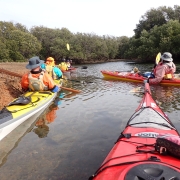
Next morning was chilly and foggy, giving the river a surreal atmosphere. After a hot coffee and some breakfast we packed up wet tents and headed out on the river again. We were making good time with the current, so we decided to detour into Monoman Creek, at bit longer and narrower, but also more scenic. This area is normally popular with campers, but with the cold weather and it being a week day, we had the place to ourselves. After re-joining Chowilla Creek, the waters became wider and more sluggish as we approached the Murray River again. I was very confused as we passed under the Chowilla regulator as I remembered it as being a lot larger and more imposing, until I realised that the increased water height had made it seem a lot smaller.
After about 3 km on the Murray main channel we turned into the entrance to Native Box Creek, just after Chowilla Homestead, glad to be back in the narrow secluded backwaters again. We enjoyed a slow paddle down the creek enjoying the scenery, but slightly confused by a large number of big arrows and warning tape fixed to the trees. We set up camp for the night near to the junction with Little Hunchee Creek, and were just starting to relax when we were disturbed by a number of tinnies with large motors rushing past. After some hurried searching on Google we discovered that there was a dingy race the following day, luckily some more searching revealed that we were no longer on the course, and we should be well on our way before the race started the next day. Something to check on for the next trip.
From Big Hunchee to Ral Ral

Cool and misty morning in Chowilla
Next morning was again cool and misty as we paddled down Big Hunchee Creek until we eventually entered RalRal Creek, and the waters narrowed again as we were surrounded by large gum trees. Just before Calperum Station we passed the entrance to Lake Woolpolool and, since the water levels were high, we decided to go in have a look. The lake was full, but unfortunately the waters were not high enough to paddle across the road and into the lake itself, and we had to content ourselves with sitting in the duckweed at the entrance looking over the regulator.
Back on RalRal, we continued ambling down the creek past the gum trees and picking our way through the snags until we reached the Wide Waters section of the river. Here we were treated to a flock of pelicans and the occasional swan taking advantage of the large body of placid, sheltered water. We found the entrance to Nelbuck Creek with no problem thanks to the GPS, and paddled slowly upstream back towards the Murray. We set up camp for the last time a few hundred meters before the Murry, where the creek was still narrow and the gum trees still large.
Horseshoe Lagoon
Next morning we were treated to the sight of a large emu wandering around completely unfazed by us, probably because he was on the opposite side of the creek. Camp was packed up quickly, either due to practice, or the desire to get back to the cars, and we were soon on the Murray heading downstream and looking for the entrance to Horseshoe Lagoon. The waters changed after we entered the lagoon, with gum trees slowly being replaced with reeded banks as we made our way through the maze of channels towards our finishing point at Canoe-The-Riverland.
The drivers were send off to retrieve our cars from the launch point while the rest of us slowly unpacked our kayaks and enjoyed the sun. Kayaks were quickly loaded, and we headed off to the nearest bakery for the customary coffee and pasty.
Map and GPX file
Click in the image below to access the map of the trip and its corresponding GPX file

Chowilla RalRal Map
 Launching from Garden Island boat ramp the group worked upwind across the Angus Inlet and some way up the Barker Inlet to get a fast downwind ride to the entrance to Hidden Creek. It has this name due to the entrance being indistinct and partially blocked by fallen trees. The entrance is on the eastern side of Eastern Passage just under the power lines. Once in the shelter of the creek conditions were ideal. Out of the wind it was much warmer, the water crystal clear and the winding nature of the creek made it feel adventurous! Phil and Bella were in a Mirage 730 double with Kaye and Stephen in their brand new Prijon double. Turning these longer kayaks to negotiate the ever sharpening bends tested sweep stroke technique, strength and endurance!
 Hindsight is a marvellous thing! Well before reaching the back of the creek we ran out of water, the tide was not quite ideal! And this is where the Bog challenge began! Those in single kayaks were able to turn around (just) to begin the journey out. No so those in double kayaks.
 There was no easy solution to get the M730 turned around so one end was shoved up onto the scrub and the rest lifted from the water to point it in the other direction. Phil and Bella then got in, taking quite a bit of smelly mud with them, and began paddling back. Well it was a mix of paddling, pushing off tree stumps and poling through the mud trying to weave through fallen branches and areas too shallow to float the boat!
 The wind was still blowing quite strongly so after a quick discussion Kaye and Stephen opted for a direct route back while others wanting more punishment headed on to the “Ships Graveyard”. It was a fun ride downwind and into the North Arm to view the remains of the Dorothy H Sterling and Santiago. These two relics are a link to the maritime past of South Australia. The Santiago was one of the first iron hulled ships ever made and was launched in Glasgow, Scotland in 1856. The Dorothy was launched in Oregon in 1920 and was one of the largest commercial sailing ships of it’s era. Unfortunately, it became a victim of the Great Depression. Upon arriving in Port Adelaide in 1929 it’s crew found that the company that owned the boat had gone bankrupt and no money was waiting for them for wages and landing fees. Eventually the Dorothy was impounded and put to auction to recoup the losses. The stunning six masted schooner was sold off for £50 then dismantled for scrap. The full stories of these relics can be found online.


